There is a word that is uniquely used by the KJB translators. This one English word, out of hundreds, is among many other “infallible proofs” that God inspired the translators in the choice of words used to write upon the “table of flesh” and that transcends time.
We are told that the “words” of God are powerful and have unique qualities.
| Psa 12:6 (KJV) The words of the LORD are pure words: as silver tried in a furnace of earth, purified seven times.
Psa 119:130 (KJV) The entrance of thy words giveth light; it giveth understanding unto the simple. |
These passages emphasize not merely themes or ideas, but the individual words themselves. Among these words is one that appears only twice in the entire King James Bible — a word that shapes the very definition of faith: evidence.
This article argues that the KJB’s use of the word evidence in Hebrews 11:1 is both historically consistent and theologically intentional, rooted in the first biblical appearance in Jeremiah 32. Through this connection, the KJB translators preserved a profound doctrinal thread that earlier English translations had already established. One such word is found in the very definition of “faith” itself. For we are told that “faith cometh by hearing and hearing by the word of God”. It’s no surprise that this simple word is used by God to help “increase our faith “.
EVIDENCE
The definition of the word itself seems quite “regular”.
EV’IDENCE, n. [L. evidentia, from video, to see.]
1. That which elucidates and enables the mind to see truth; proof arising from our own perceptions by the senses, or from the testimony of others, or from inductions of reason. Our senses furnish evidence of the existence of matter, of solidity, of color, of heat and cold, of a difference in the qualities of bodies, of figure, &c. The declarations of a witness furnish evidence of facts to a court and jury; and reasoning, or the deductions of the mind from facts or arguments, furnish evidence of truth or falsehood.
The KJB translators could have used other words besides evidence. They could have “bucked” the trend that earlier translations like the Bishop Bible or the Geneva Bible used. But they didn’t. They could have used Tyndale’s translation. All these translations used the same Greek manuscripts.
Comparison of Early English Translations
- Tyndale (1534): “Fayth is a sure confidence… and a certayntie of thynges which are not sene.”
- Geneva Bible (1560): “…and the euidence of things which are not seene.”
- Bishop’s Bible (1568): “…the euidence of thynges not seene.”
The KJB translators retained the Geneva/Bishop wording rather than Tyndale’s. This continuity suggests deliberate preservation of ecclesiastical vocabulary familiar to English-speaking believers.
Besides the spelling not meeting our modern spell checker’s standards (oh the headaches of copying and pasting the kings English into a modern word processor) Tyndale used completely different words for “substance” and “evidence”. But why did he? Because He had a few words to choose from. The Greek word for evidence is.
ἔλεγχος
elegchos
el’-eng-khos
From G1651; proof, conviction: – evidence, reproof.
Two words, proof and conviction. In a modern thesaurus I’m confident that “certainty” might be among the list of words as well.
So why did the KJB translators use “evidence”? The answer is twofold.
First, they wanted to keep with what the people of God had used the last several decades found in both its predecessors, the Bishop and Geneva Bible.
But the second reason, which I believe is the most compelling reason, is the “first mention” of the word “evidence” itself.
The Law of First Mention — A Hermeneutical Key
| One of the most important principles of biblical interpretation is the Law of First Mention. The KJB’s consistent application of this principle is powerful evidence of its translational purity and theological intentionality. |
1 Defining the Law of First Mention
The Law of First Mention is the hermeneutical principle that the first time a word, name, concept, or theme appears in Scripture, that appearance establishes its foundational theological meaning — a meaning that is then carried forward, developed, and deepened throughout the rest of the biblical canon. This principle is not merely a man-made interpretive convention; it reflects the divine authorship of Scripture. Because one God authored all 66 books, He may be expected to have introduced key theological concepts deliberately at their first occurrence, establishing a semantic and theological foundation for all that follows.
The King James Bible carefully honors this principle through consistent, theologically sensitive translation choices. Modern versions frequently disrupt it by rendering the same Hebrew or Greek word with different English words in different contexts — sometimes for stylistic variety, sometimes due to translational philosophy — fracturing the theological threads that God wove into the fabric of Scripture.
Example — “Grace”: First Mention in Genesis 6:8 (KJV)
| “But Noah found grace in the eyes of the LORD.”
— Genesis 6:8 (KJV) |
This is the first occurrence of the word “grace” in the entire Bible, and its theological significance cannot be overstated. Noah did not earn God’s rescue — he found grace. The doctrine of grace — unmerited divine favor bestowed upon undeserving sinners — is established here at the very outset of redemptive history. The Hebrew word chen (חֵן) means favour, kindness, grace — and the KJB translates it consistently and accurately as “grace” in this foundational passage.
The significance of this translation extends to the New Testament, where the Greek word charis — the direct conceptual equivalent of chen — is likewise rendered “grace” throughout the KJB. This creates an unbroken theological chain from Genesis 6:8 to the epistles of Paul: grace saves, grace sustains, grace glorifies. The KJB’s consistent rendering preserves this thread intact.
Modern versions that render “grace” as “favor” (using American spelling), or that vary their translation of charis across the New Testament, sever these connections. The reader of a modern version may not perceive that what Noah found in Genesis 6 is the same principle by which every sinner is saved in Ephesians 2:8 — but the reader of the KJB sees it plainly.
Example — “Evidence”: First Mention in Jeremiah 32:10 (KJV)
| ” And I subscribed the evidence, and sealed it, and took witnesses, and weighed him the money in the balances
— Jeremiah 32:10 (KJV) |
| “And I subscribed the evidence, and sealed it, and took witnesses…” (Jeremiah 32:10, KJV) “So I took the evidence of the purchase…” (Jeremiah 32:11, KJV) “And I gave the evidence of the purchase unto Baruch…” (Jeremiah 32:12, KJV) “Take these evidences… and put them in an earthen vessel, that they may continue many days.”
(Jeremiah 32:14, KJV) |
| “Now faith is the substance of things hoped for, the evidence of things not seen.”
Heb 11:1 |
Only in the KJV will you find this unique sequencing of this word and its usage. All modern translation departs from the use of the word “evidence” and confuses what the “Spirit of Truth” is teaching; John 16:13. Therefore breaking the chain and removing the ability to apply the command of “comparing spiritual things with spiritual” and studying to show ourselves unashamed workman.
 |
|
Jeremiah is in prison for his prophecies against Jerusalem and its people. He had repeatedly warned the people to submit to the Babylonian king, or they would be killed by the Babylonian army. That the remnant would be carried away to Babylon for seventy years. Because of the word of God, the king had him thrown into jail. While in jail God commanded him to redeem a piece of property: being a near kinsman it was his right to redeem; v 8. This would be “evidence” of God’s promises. That he had not forgotten about his people nor his land.
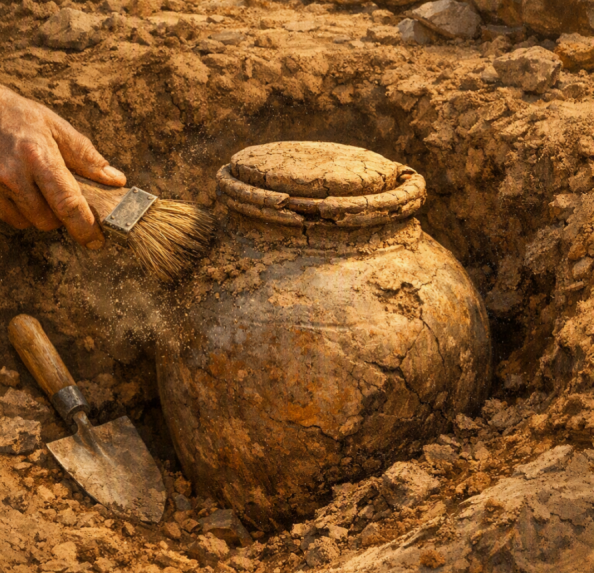
The evidence, being the piece of property, was bought. The witnesses saw the exchange of money, according to the law. It was written on parchment and sealed in an earthen vessel for a future generation.
Thus, the first biblical use of evidence is tied directly to redemption, promise, future restoration, and faith in what is not yet seen.
| I have also spoken by the prophets, and I have multiplied visions, and used similitudes, by the ministry of the prophets. — Hosea 12:10 (KJV) |
Typological Parallels Between Jeremiah 32 and Hebrews 11:1
The theological richness of this connection becomes clear when viewed typologically:
1. The Kinsman Redeemer
Jeremiah, as nearest kinsman, redeems the land. Christ, our Kinsman Redeemer, purchased us with His own blood.
2. The Price of Redemption
Jeremiah pays seventeen shekels of silver. Believers are redeemed with the precious blood of Christ.
3. Witnessed and Recorded
Jeremiah’s purchase is witnessed, written, and sealed. Christ’s sacrifice is witnessed by Jew and Gentile, recorded in Scripture, and fulfills all the sacrificial laws:
| For if the blood of bulls and of goats, and the ashes of an heifer sprinkling the unclean, sanctifieth to the purifying of the flesh: How much more shall the blood of Christ, who through the eternal Spirit offered himself without spot to God, purge your conscience from dead works to serve the living God?
(Heb 9:13-14) “Without shedding of blood is no remission.” (Hebrews 9:22, KJV) |
4. A Token of Future Restoration
Jeremiah’s deed, sealed in an earthen vessel, is a pledge of future possession. Believers receive the indwelling Holy Spirit and are “sealed” as the earnest of our inheritance.
Paul echoes this imagery:
| “But we have this treasure in earthen vessels…”
(2 Corinthians 4:7, KJV) |
Just as Jeremiah’s evidence was preserved in clay jars, our faith — grounded in Christ’s redemption — is preserved within our mortal bodies, through the indwelling Spirit of God, until the day of full restoration and redemption of the body. A token of the future promise that God, who can not lie, has taken upon himself the promise of eternal life.
We conclude that the evidence is unmistakenly clear that the pure preserved words of God are bound in the pages of the KJV.