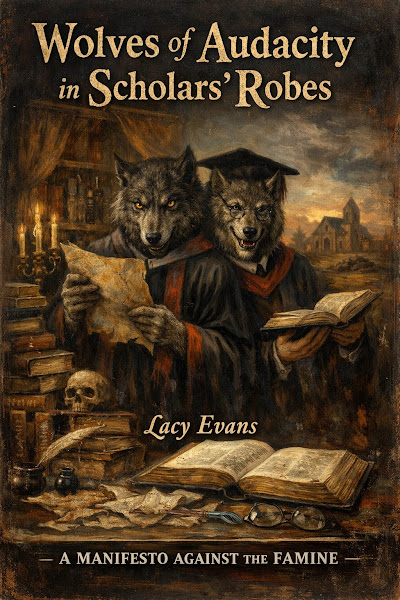
A MANIFESTO AGAINST THE FAMINE
On the Collapse of Preservation, the Audacity of Scholars, and the Silence That Followed
I. We Are Not Short of Bibles—We Are Starving for Hearing
Every hotel room has a Bible. Every grandmother’s coffee table has a Bible. Every phone can summon a thousand translations in a second. And yet the Church is experiencing famine.
“Not a famine of bread, nor a thirst for water, but of hearing the words of the LORD.” (Amos 8:11)
This is not a famine of ink but of voice. The Scriptures have not vanished—they have been disenchanted, treated as a problem to solve rather than a word to obey. We know the syllables, but we no longer hear the Speaker.
II. The First Question Was Not Denial, but Doubt
The serpent did not begin with rebellion; he began with scholarship.
“Yea, hath God said…?”
This is the original academic maneuver: not contradiction but qualification, not denial but destabilization. Once the words are made uncertain, everything that follows becomes negotiable. The Church did not fall because it stopped reading Scripture; it fell because it learned to stand over it instead of under it.
III. Preservation Was Not Refined—It Was Replaced
For most of Christian history, the Church believed something simple and terrifyingly bold: God inspired His word—and God kept it. Preservation was not a footnote but the foundation. Scripture was received, guarded, sung, preached, memorized, and suffered for. It was not provisional or hypothetical; it was the voice of God, present and active. Then came the shift—not a small correction. Westcott and Hort did not merely critique readings; they introduced a new cosmology. The Bible was no longer something God kept; it was something scholars must recover. Authority moved from the text to the technician, from inheritance to excavation. The Church was told—politely, academically—that she had been reading a draft for fourteen centuries. This was not refinement; this was paradigm collapse.
IV. From Received Word to Reconstructed Word
Once Scripture became reconstructed rather than received, it became permanently unstable—every verse provisional, every word footnoted, every doctrine “under discussion.” The text did not lose its ink; it lost its finality. And a word without finality is a word without teeth.
V. Dynamic Equivalence: When Meaning Is Cut Loose from Words
If textual criticism loosened the foundation, dynamic equivalence cut the moorings. We were told that God inspired ideas, not words—that form is expendable, that meaning can be preserved even if wording is replaced. But Jesus did not say, “Man shall live by inspired concepts.” He said, “By every word.” Once words are treated as vehicles rather than vessels, translators become interpreters, and interpreters become editors of conscience. This is how “Thou shalt not” becomes “Perhaps you shouldn’t,” how judgment softens, edges blur, and obedience is delayed in the name of nuance.
VI. Seminaries: Ground Zero for Institutionalized Doubt
Modern seminaries do not usually teach unbelief—they teach something far more corrosive: permanent hesitation. Students graduate fluent in caveats, allergic to certainty, suspicious of confidence. To speak plainly is to be unsophisticated; to trust the received text is to be naïve. Thus, attacking the KJV becomes a badge of authority—not because it is weak, but because it is stable. You cannot easily govern a people who can quote Scripture without footnotes. And here lies the irony: there are vanishingly few scholars today—if any—with linguistic breadth equal to the KJV translators, men fluent across Hebrew, Aramaic, Greek, Latin, and cognate languages, steeped in patristics, theology, and classical literature. Yet modern critics, armed with lexicons and apparatuses, speak over them with breathtaking audacity. These are not shepherds correcting a flock; they are wolves of audacity wearing the robes of scholarship.
VII. The Bible Was Not Removed—The Voice Was
God’s judgment is never crude. He does not burn the books—He goes silent. No prophet, no Urim, no Thummim, no open vision. Israel still had scrolls when Amos spoke; what they lacked was hearing. The modern Church is no different. We study endlessly, revise constantly, and submit rarely. We re-translate rather than repent. We parse rather than tremble. And so God withdraws the thing we no longer value: His voice.
VIII. From Doubt to Delusion
Paul warned of a final consequence: “Because they received not the love of the truth… God shall send them strong delusion.” Delusion is not sent to those who never had truth, but to those who treated it lightly. The famine comes not because Bibles are scarce, but because belief is.
IX. This Is Not Nostalgia—It Is Survival
This is not a plea to canonize English; it is a plea to recover fear of God. A Church that no longer believes God can preserve His word will never believe Him enough to obey it. And a Bible forever “under revision” will never function as a sword.
X. Final Word: Choose This Day
The question before the Church is not, “Which translation do you prefer?” It is: “Do you believe God speaks—or merely that men discuss Him?” The famine is here. The shelves are full. The voice is faint. “He that hath ears to hear, let him hear.”